Wednesday, October 26, 2011

A few of the little hotels along our way where we did NOT stay, a few little shops where we did buy, a few little clinics where we did visit...

 
Posted by Picasa

Lake Nakuru -- a magical place in Kenya


Until next time... almost as if to bid as farewell, a last magical moment as the sun lights up the beautiful Lake Nakuru in the distance

Shani and Emy cuddling up on the floor of our NEW truck to watch a movie

This one is for Shani
Like a Garden of Eden

The pelicans floating on the thermals
Quite strange and incongruous to see the town of Nakuru in the background as this must surely be the most placid and serene lake anywhere. You feel as if you are in a lost world and the first humans to stand on its edge, overawed by the glass-like stillness, the crystal clear reflections, the wonder of the beautiful birds everywhere
Wherever you looked, more species of bird. We tried to see who could get the most species in one shot!

Of course! -- I am sure you would agree this was most definitely
yet another Red Button Moment
bird tracks on the side of the lake -- looks almost prehistoric

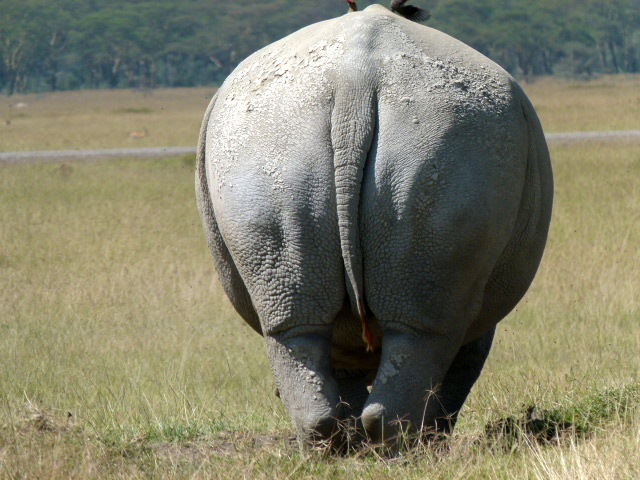
Three oxpeckers having a chat on the back of the rhino
One would have said this white rhino thought he was on a photoshoot -- he showed us every one of his angles. This is the one I liked best!

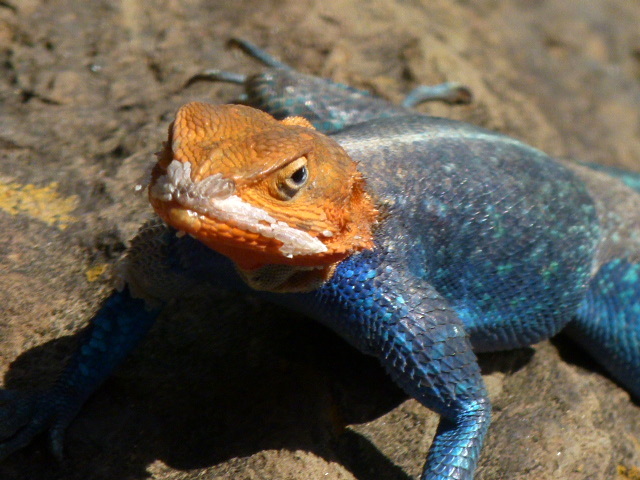
Why he gave me such a dirty look is not clear. Perhaps I should have offered to pay him for the photograph? So similar to the agamas we have seen ever since Mali, and yet a little more ferocious looking
Dassies (Hyrax) lazing in the sun
not sure whether the sky was reflected in the water or the water in the sky...


Bird of Paradise Shani


See no evil (but David peeked), hear no evil (but Rebecca giggled), speak no evil (but Emy spluttered)

A waterbuck bull - proud and regal
The baboon pictures are for Zara...
For Zara
For Zara

Big herds of healthy looking buffalo roam the plains around the lake


Lake Nakuru lies in Central Kenya, 140km north-west of Nairobi, in Nakuru district of the Rift Valley Province. The ecosystem comprises of the lake, surrounded by mainly wooded and bushy grasslands. The park supports a wide ecological diversity with Flamingos (Greater and Lesser) and other water birds being the major attractions of the area. The ecosystem provides for about 56 different species of mammals including the white rhino and buffaloes and a variety of terrestrial birds numbering nearly 450 species.

The vegetation is mainly wooded and bushy grassland with a wide ecological diversity and characteristic habitats that range from the lake waters to the escarpment and ridges.
The normally water-covered surface of the lake occupies about a third of the park. The lake water supports a dense bloom of the blue-green Cyanophyte Spirulina platensis from which it derives its colour and which is the major food source for the flamingo.

The lake is fringed by alkaline swamps with areas of sedge, Cyprus laevigatus and typha marsh along the river inflows and springs. The surrounding areas support a dry transitional savanna with lake margin grasslands of Sporobolus spicatus salt grass moving into grasslands of Hyparrhenia hirta and rhodes grass Chloris gayana in the lower areas.

More elevated areas have dry forest with Acacia xanthophloea, olive Olea hochstetteri and Croton dichogamus; Euphorbia candelabrum forest; and bushland dominated by the composites, Mulelechwa Tarchonanthus camphoratus and Psiadia arabica

A very special tree in Nairobi...


At the legendary Stanley Hotel in Nairobi, Kenya, stands a very special tree.


From the early 1900's, there used to be a famous railway line that lay like a slender black gleaming snake right across the length of the African continent, from Cape Town to Cairo one could travel in the luxury of a puffing, chugging steam train. Imagine! Crossing the vast savannas of this great continent, steaming through the dense jungles, skirting the giant lakes and inland seas, sipping tea at eleven and buttering cream scones as you gaze over the hills of the highlands of British East Afrika, or listening to the sweet tones of the old grand piano as the ice tinkles in your gin and tonic and you watch the sun set over the dales of Tanganyika. And then, when you reach the excitement of the frontier town of Nairobi, you step off the train for a few leisurely days' stay at the elegant wood-panelled Stanley Hotel where you can wash off the dust and grime of the journey in a hot steam bath and mix and mingle with the rich and the famous, the great white hunters and the smooth-talking entrepreneurs who are looking to Africa for their fortunes, the diplomats and the colonial officials, the authors and the biologists.

And then, after a few days, you board the train once again where it has stayed parked in front of the hotel, and resume your journey to the land of the pyramids and pharaohs.

And, during your sojourn, you will spend some time under the great old thorn tree which stands in the courtyard of the hotel's tea room where, if you are lucky - you will find a little note pinned for you by a lover, a friend, a relation, an associate, who had passed by this way some time before.

The "message tree".

The mystic nature of the acacia tree as a 'messenger' is as old as the Bible when people left messages for each other either pinned or tied to trees along a pathway. In Japan is lovely custom of tying prayers written on strips of paper to the branches of trees. Here in Nairobi, the tree became the 'post office' of the African traveller more than a century ago.


And today, although the original thorn tree (genus acacia xanthophildea) does not exist anymore, the current young tree is a third generation sweet thorn that stands in the same spot as the original. Instead of pinning messages onto the tree it self, there is now a notice board around the tree where you can find messages left by fellow travellers, backpackers, adventurers, and explorers of our time. And although the railway track no onger passes in front of the hotel as it did then, the Thorn Tree remains the most famous meeting place in East Africa.

Way back in 2003 I flew to Nairobi to meet up with my children who were then, as I am doing now, travelling through the continent on the back of a truck. My daughter had been ill and I needed to assure myself that she was going to be all right, and I also desperately needed by that time to get a big hug from my son again -- and meet my future daughter in law, so I booked myself into the Stanley Hotel and my daughter and I spent two days talking and talking, she had one hot steaming foam bath after another, we went shopping for a 'new aura' for her -- a brand new turquoise and pink tent with a roof that could open to the stars at night, and in a little ceremony where we painted each other's toe nails a bright blue, we made a pact to come back to Africa one day and do something to make a contribution to making the world a better place -- and meet at the Stanley Hotel in Nairobi.

I wrote a message of welcome for her on a piece of paper at the time and pinned it on the thorn tree -- in case she should arrive there before I did. As it happened, she did return to Nairobi not too long after to work for a UN ngo involved in the repatriation of Sudanese refugees at Kakuma near the Northern border - and as a result -- long story -- decided to to study medicine, which she has now done. It took me much longer to get back - and sadly not - as yet - with any such noble contributions. So this time, when I went to the Thorn Tree, I left another note -- this time for my granddaughter -- and the note is now pinned to the tree with a red button attached...

Perhaps, one day soon, you will be able to read the message I wrote for her on the Thorn Tree blogspot. Click on http://stanleythorntree.blogspot.com and have a look at some of the messages that are there today. No tips on where to find the biggest tuskers on the next hunting expedition or where Rich got mauled by a rogue lion or where Cynthia suggests she and Rodney could possibly meet without her husband finding them or where Aunt Emily hopes to catch up with her cribbage party in Upper Volta, but the messages are as charming and heartwarming and touching and romantic.

And I hope the tree will keep my red-buttoned note to Zara safe -- until she too, one day, comes travelling through Africa and stops at the Stanley Hotel to pick up her messages...

Stepping back for one more moment: The spectacularly unique Serengeti and Ngorogoro Crater, Tanzania Part Three (the last one: The Crater)


The jewel in Ngorongoro's crown is a deep, volcanic crater, the largest un flooded and unbroken caldera in the world.
Ngorongoro means 'The Cow Bell" - and it is such an apt name as the crater is surrounded by the pasture land of the Maasai where their magnificent big horned cattle graze, as they have been doing for thousands of years.
About 20kms across, 600 metres deep and 300 sq kms in area, the Ngorongoro Crater is a breathtaking natural wonder.
All I know is that it took my breath away when, still dark, we crested the rim and started making our way down the side into the crater. And then, when the sun started peeping over the rim on the opposite side and breaking through the thick cloud cover that sat like a lid on top of the crater, throwing a distinct spotlight on the huge flat bottom of the bowl, I started crying. It was simply too much beauty to absorb. It was overwhelming. It was the wonder of nature at its most splendid, at its most spectacular, at its most awesome. A beautiful cow bell, perfect, unique.


The eland -- the biggest antelope, surrounded by the ubiquitous Thompson's gazelles
Just after we had started to descend the 600metre rim of the crater -- a wall almost straight down, we came across this big old tusker. A Massive elephant that had obviously seen some action in his long life - and with tusks the size of which I have not seen in many many years.


It was a cloudy day when we entered the crater. The effect was that it was like being inside a large stadium with a roof cover, as the clouds seem to lay on the edges of the rim that runs all round the crater -- forming a lid. The consequential atmosphere is slightly muggy, slightly warm, strangely silent, eerily secretive -- as if we had left the world outside and entered another space, another time, another hidden place -- a little bit like the twilight zone! Not too good for photographs, but making it more of a spiritual experience.


A lone Grant's gazelle wandering over the open plain

Along the bottom of the rim is the occasional forested area where most of the elephants seem to hang out.Here, another huge tusker! Seems that it needed a hidden place like the crater bowl for elephants to come to grow as nature had intended for them - so old and so peacefully that their tusks can reach these huge proportions.

My father used to take my children on Sunday mornings to the Austin Robert Bird Sanctuary in Pretoria, near our home. And their favourite bird -- for all three my children, was the Crowned Crane. In the crater there are many pairs and, in places, there were even up to thirty or forty pairs together. "They are probably here on holiday from Uganda," said Livingstone, with a smile. "Most of our tourists are mazungu's (white people) but on occasion we get some Africans visiting the Reserve -- especially these cranes from Uganda." (The crowned crane is the national bird of Uganda and do migrate south during the colder months) But then, Livingstone also told us all the animals were lying down because it is winter! This became our little in-joke during our time with him -- he was probably one of the best ranger/wild life guides I have ever met and his knowledge seemed to be limitless. All the little idiosyncrasies of every animal, habits, diet, mythical stories, as well as the best eyes -- he could see a lizard in a tree at fifty metres -- an excellent guide for our time in the Serengeti and Crater.


The mass migration happens towards the end of October, but there was still thousands of wildebeest and other herd animals. The wildebeest here are the Whitebearded Wildebeest -- all sporting a white beard the boys in our groups were very envious of!


This couple were thoroughly enjoying a freshly killed wildebeest. Their two cubs wandered around patiently in the distance while their parents continued to eat. But the amazing thing about this scene was the scavengers hanging around in the neighbourhood, waiting their turn; there were hyena, blackbacked jackal (the least patient -- they even managed to grab a morsel of meat every now and then right out from under the noses of the lions), golden jackal (who seemed to have befriended a hyena) and a tawny eagle -- all waiting for the lion pair to finish their meal.


The flamingoes -- a splash of bright pink on the soda lake


Livingstone - our excellent guide. For some reason I started calling him Sylvester -- some of my readers know me -- I tend to associate different names with people than those their parents had given them. Why Sylvester? How did I get there from Livingstone? Perhaps somebody out there can explain!

And -- there was so much more! But my camera battery ran out! So -- as soon as Shani Fraser sends me her stunning photographs of the big pride of lion we saw, I shall be sharing it with you -- trust me -- well worth the patient wait!